Why building better futures for children is smart business

This piece was written by Ian Stephenson, Associate at ReGenerate.
The most critical window for physical, cognitive, and emotional growth occurs between birth and age five, a period when children and parents engage daily with everything from food to financial tools to digital media.
Yet, the long-term impact on a child’s development is often missing from a business’s thinking when designing or delivering their products or services. The result can have an impact on a child’s development, health or future opportunities. There is therefore a significant untapped opportunity for businesses to intentionally design for children’s developmental outcomes, recognising this as an investment in their future workforce. This can drive both social impact and commercial success.
The economic case for this shift is compelling. The Royal Foundation Business Taskforce for Early Childhood estimates that prioritising our children could unlock a £45.5 billion opportunity for the UK economy. This would be achieved through improved skills for supporting children, reduced public spending and the benefits of investing in working parents. Prioritising early childhood in products and services emerges as a “triple win”: it accelerates a child’s developmental milestones, enhances parents' engagement at home and work, and fuels sustainable commercial growth.
Why should businesses prioritise early childhood in the design of their products or services?
1. Revenue Growth: UK businesses could unlock up to £3 billion in revenue by prioritising children’s safety and developmental features. 63% of consumers are willing to pay a premium for products that demonstrate child-centred design.
2. Enhanced Trust: 71% of adults consider companies who prioritise children’s safety and well-being are significantly more trustworthy. For businesses, this trust translates into lower customer acquisition costs and higher brand resilience.
3. Maximizing Lifetime Value (LTV): Child-centered design and increased trust create a cycle of loyalty. 60% of adults maintain brand preferences established during their youth.
Which products and services have the highest impact on early childhood?
There is precedent. Across industries UK businesses are increasingly involved in shaping the ecosystem that supports early childhood development, either individually or through collaboration with partners, and even competitors.
1. Food and nutrition: Healthy eating in the early years is the single greatest predictor of long-term health and "school readiness." Sainsbury’s provides a £2 weekly top-up to the Healthy Start scheme, which enables low-income families to buy fresh and healthy food.
2. Video and Digital Content: With digital consumption like YouTube outpacing traditional TV, the "passive scroll" has become a developmental risk, often leading to reduced attention spans. Hopster reimagines the "screen time" debate by creating a "digital playroom" specifically for the 0–5 age bracket, which is advert free and promotes physical activity.
3. Financial Services: The arrival of a child is often a "financial shock". UK banks typically treat parents as a general demographic rather than a specialised segment with unique needs. Sheffield Credit Union’s Family Loan adopts a "save-as-you-borrow" model allowing parents to manage immediate expenses, like a new car seat or nursery fees, while automatically building a savings buffer for their family.
Supermarkets are uniquely placed to help drive healthy diets in the early years
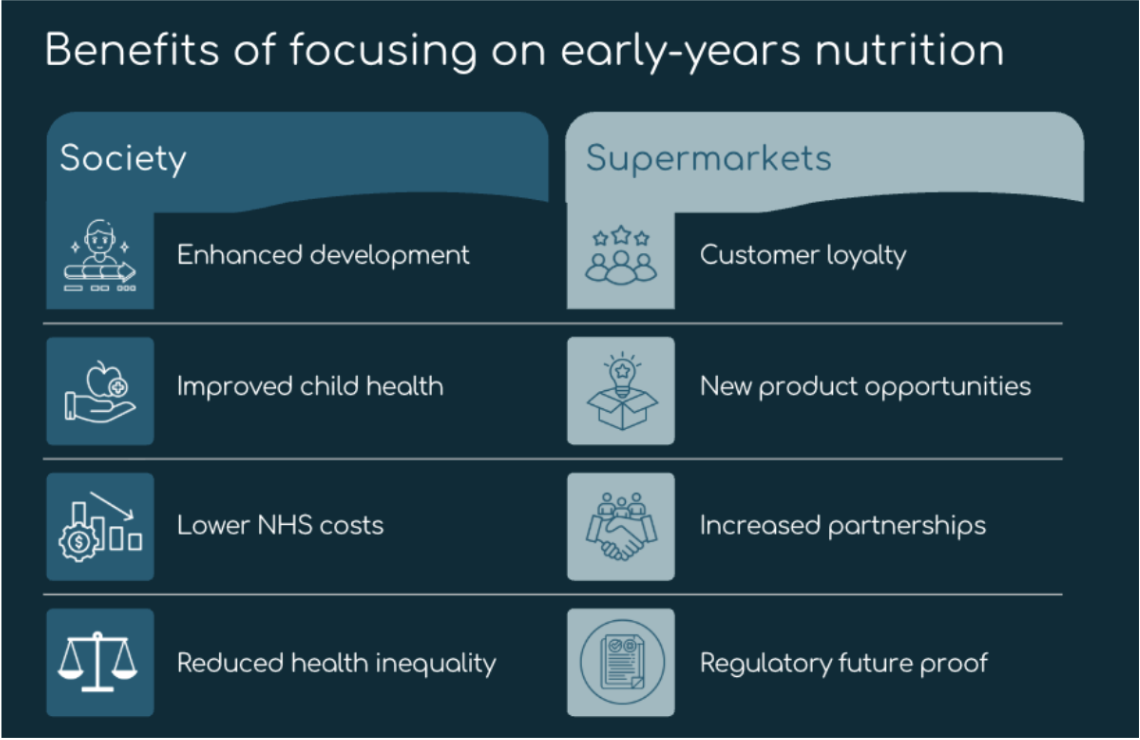
Researching how Supermarkets can best improve nutrition outcomes for young children has been selected as our first area of research. Supermarkets account for over 80 percent of total UK grocery spending, an average of £74 per household per week. They are therefore exceptionally well placed to drive positive nutritional change for children because of their scale, reach, and trusted role in people’s lives. However there are significant challenges linked to children’s health and nutrition, including obesity levels, high consumption of UPF (ultra-processed foods), high sugar intake and a prevalence of tooth decay in under fives.
ReGenerate have engaged over 10 organisations, including major supermarkets and nutrition focused non-profits to understand existing initiatives and help identify business focused solutions which improve nutrition for young children. Our insight resulting from these conversations will be published shortly. This paper will illustrate how supermarkets can improve young children’s diets, delivering both commercial and societal benefits.
Watch this space!
We’re delighted that our paper on how supermarkets can help to improve nutrition for young children will be published later in February 2026. We’ll also be sharing further details on our financial services research so watch this space! Follow us on LinkedIn to keep up to date.
Interested in finding out more? Please reach out to Amie Kendall, ReGenerate’s Business Director and lead for our Early Childhood Development project.