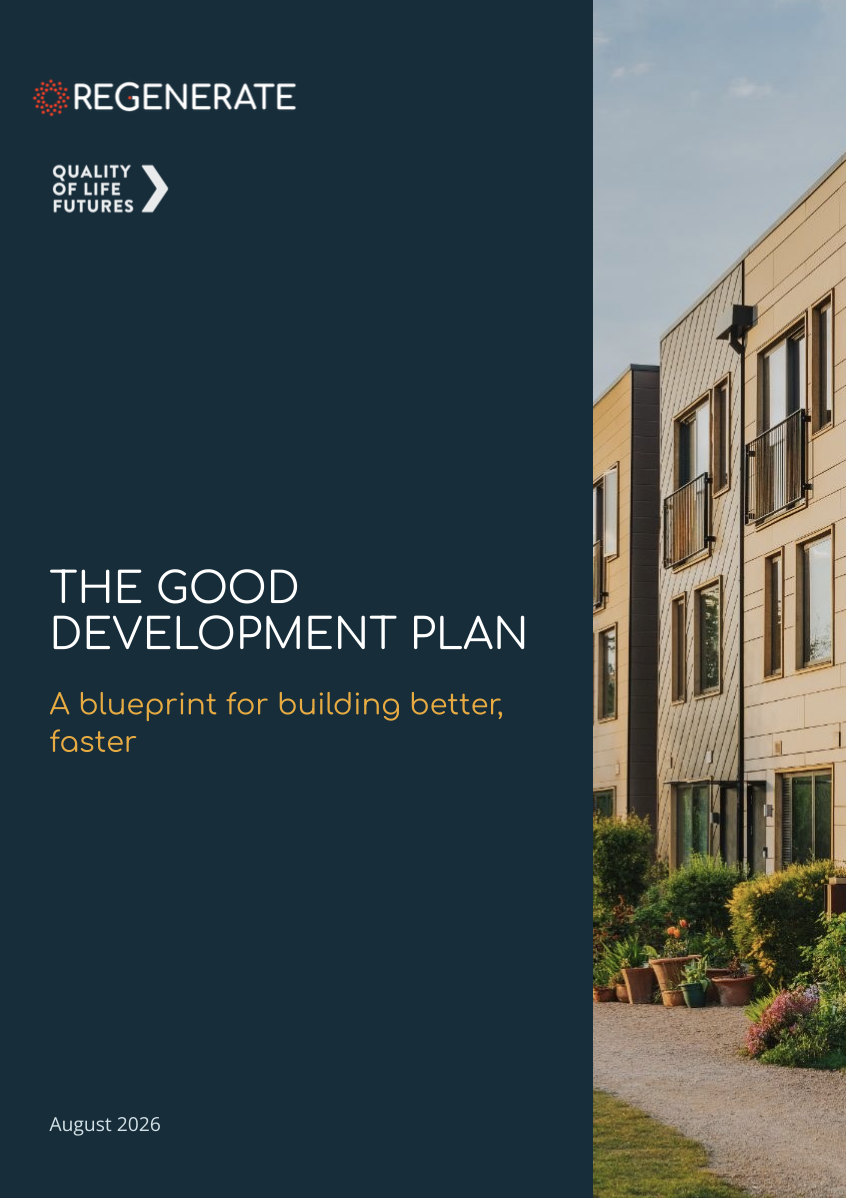
The Good Development Plan: A blueprint for building better, faster
Housing is one of the defining challenges of our time. More than 176,000 children are growing up in temporary accommodation, house prices now stand at eight times average earnings (double the ratio of a generation ago), and rough sleeping has risen to the highest level on record.
The Government has rightly made this a priority. The Prime Minister has committed to launch "the biggest council-housebuilding programme since the post-war era", and has pledged to move thousands of rough sleepers off the streets by Christmas.
But the Government cannot achieve these ambitions alone: it needs genuine partnership with developers. And while the new National Planning Policy Framework (August 2026) is designed to deliver new homes faster, speed and volume alone won't fix the housing crisis. As long as developers continue to struggle to make schemes viable, simply building more houses won't make housing more affordable.
More pertinently, building more of the same risks patching over one crisis while further entrenching others: the built environment currently contributes 25 percent of carbon emissions in the UK; thousands of families inhabit buildings which are damp and cold in winter and dangerously hot in summer; and poor designs and short-sighted planning have left our vital infrastructure vulnerable to extreme weather events.
There is a better way, and it is already proving its worth.
Purpose-driven development is an integrated, long-term approach to placemaking that intentionally delivers for people, place and planet to achieve robust, long-term profit. It proves that profit and positive outcomes are not a trade-off but mutually reinforcing: the commercial case is powered by the mission, not sacrificed to it.
Pioneers across the country, from SMEs and B-Corps to FTSE100 corporations, are already building homes and neighbourhoods that genuinely tackle the housing crisis while improving health outcomes, increasing energy security, and driving good growth. Today, though, they succeed despite the system, not because of it.
Drawing on primary research with more than 20 developers and built-environment experts, including The Crown Estate, Landsec and Muse, this report sets out how the Government can realign the built environment system around truly good development. It builds directly on recent reforms and the updated NPPF, with 14 practical interventions across five areas:
Reforming value measurement, through post-development assessments, outcomes-based certification, and valuation reform so that long-term value finally counts.
Realigning funding and incentives, by embedding outcomes in the National Housing Bank, unlocking patient pension capital, and rewarding strong performance through the tax regime.
Strengthening public-private partnerships, including retaining a public interest in public land, piloting transparent land prices, and selecting partners based on proven delivery.
Shaping whole places, through place-based innovation sandboxes, outcomes-led design coding, and phased infrastructure-first masterplanning.
Building capability and collaboration, with two-way secondments and a Good Development Partnership with business to turn policy ambition into real delivery.
Lead Author: Bramwell Blower
Licencing: This work is licensed under Creative Commons Attribution 4.0 International (CC BY 4.0).
Attribution: You must give appropriate credit, provide a link to the licence, and indicate if changes were made. You may do so in any reasonable manner, but not in any way that suggests the licensor endorses you or your use.